Game agents: Total War and Slay the Spire
Game interfaces, evaluation and replays for language-model agents in two commercial games
- When
- 2026
I build the interfaces and evaluation tools that let language models play two commercial games with very different decisions, and record every decision so it can be inspected and replayed. Most of this page is about Total War, and Slay the Spire (with the small training pilots I ran there) is at the end.
The two games share one Python package for everything around the model: the client that calls it and retries replies that break the rules, spend limits, a record of the exact code each run used, and the supervisor that starts the game. Each game has its own interface, controllers, prompts, trace format and replay tools.
In Total War: WARHAMMER III the battle keeps moving while a language model decides what to do. I study that with live battle control, a small matched comparison between models, and harder scenario variants that test a tactical choice.
Open the interactive benchmark to compare scenarios, models and individual battles.
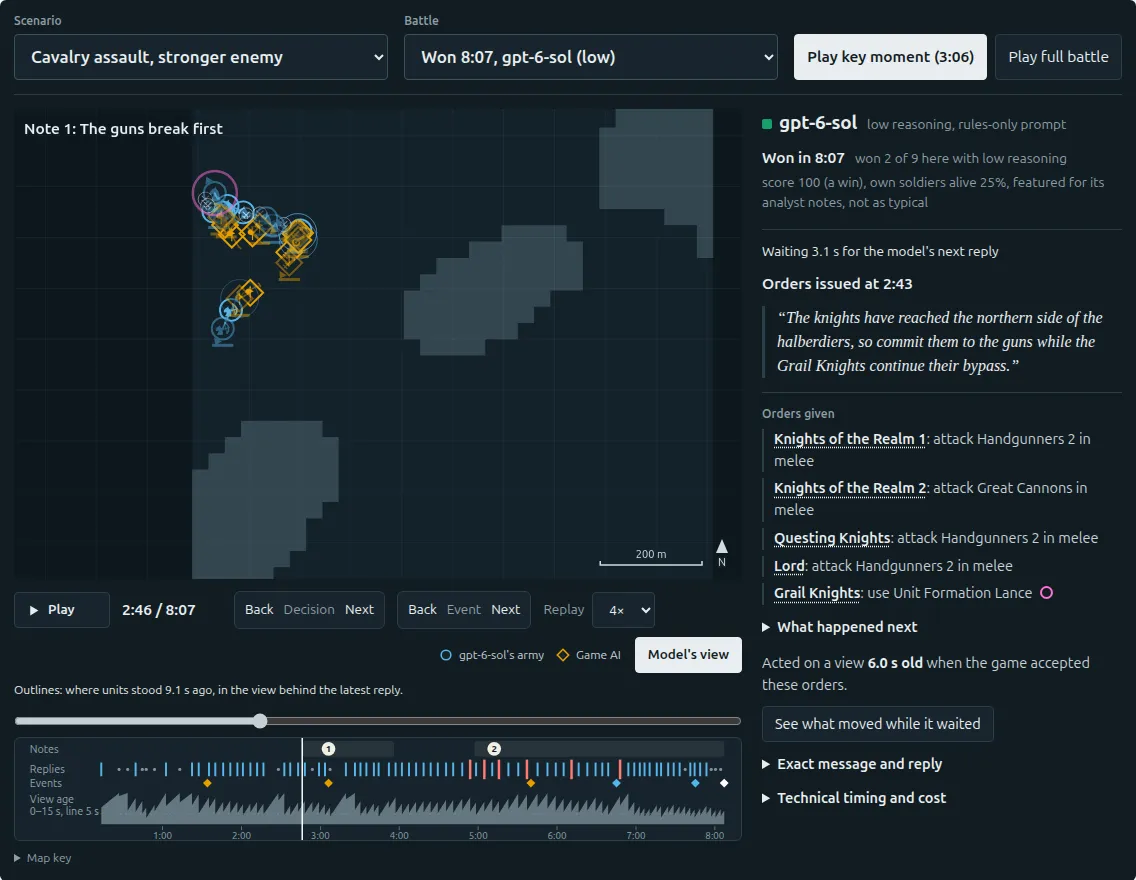
- Lord, Lord (gpt-6-sol’s army): health 68%
- KR1, Knights of the Realm 1 (gpt-6-sol’s army): 43 of 45 soldiers, in melee
- KR2, Knights of the Realm 2 (gpt-6-sol’s army): 42 of 45 soldiers, in melee
- QK, Questing Knights (gpt-6-sol’s army): 45 of 45 soldiers, in melee
- GK, Grail Knights (gpt-6-sol’s army): 32 of 36 soldiers
- MYA, Mounted Yeomen Archers (gpt-6-sol’s army): 45 of 45 soldiers
- Gen, General of the Empire (game AI): health 85%
- HB1, Halberdiers 1 (game AI): 89 of 90 soldiers, in melee
- HB2, Halberdiers 2 (game AI): 83 of 90 soldiers
- HB3, Halberdiers 3 (game AI): 90 of 90 soldiers
- HB4, Halberdiers 4 (game AI): 90 of 90 soldiers, in melee
- HG1, Handgunners 1 (game AI): 68 of 68 soldiers
- HG2, Handgunners 2 (game AI): 24 of 68 soldiers, fleeing, in melee
- GC, Great Cannons (game AI): 24 of 33 soldiers, in melee
Outlines: where units stood 7.2 s ago, in the view behind the latest reply.
gpt-6-sol low reasoning, rules-only prompt
Won in 8:073:06 / 8:07
Waiting 2.7 s for the model’s next reply.
Orders applied at 3:03reply 28 of 84
“Support the cavalry fighting around the guns while the yeomen continue to wear down the southern halberdiers.”
Orders
- Lord — use Stand Your Ground
- Mounted Yeomen Archers — shoot at Halberdiers 2
Acted on a view 4.5 s old. The battle kept running between the observation the model was given (2:59.0) and the game applying its reply (3:03.5).
Analyst note (an interpretation written after the battle)
The guns break first
Following its stated plan to go “around the south side of the central obstruction to approach the enemy flank”, the cavalry reached the gun line and fought there: Handgunners 2 began fleeing at 3:06, the Great Cannons at 3:20 and Handgunners 1 at 3:56.
Map key
- gpt-6-sol’s units
- Game AI units
- Ring: in melee
- Faded and dashed, labeled “fleeing”: fleeing
- Enemy out of sight: where gpt-6-sol’s army last saw it
- Recorded movement over the last 20 s (fainter: gpt-6-sol’s route since the start)
- Model’s view: where a unit stood in the observation behind the latest applied reply, joined to where it is now
- Move ordered in that reply, from where the model saw the unit
- Attack ordered in that reply, and its target
- A move the game rejected
- Ground the game reported as restricted at deployment (coarse 32 m cells)
- Timeline: a tick for each reply the game applied (taller where an order was rejected), and gold bands mark the analyst notes
Labels
- Lord Lord
- KR1 Knights of the Realm 1
- KR2 Knights of the Realm 2
- QK Questing Knights
- GK Grail Knights
- MYA Mounted Yeomen Archers
- Gen General of the Empire
- HB1 Halberdiers 1
- HB2 Halberdiers 2
- HB3 Halberdiers 3
- HB4 Halberdiers 4
- HG1 Handgunners 1
- HG2 Handgunners 2
- GC Great Cannons
Recorded events
What you’re looking at
Halberds are built to stop cavalry. Here four Empire halberd units screen two units of handgunners and a cannon, which are weak in melee. The model commands six mounted Bretonnian units, and its first reply set the plan: “Advance the cavalry around the south side of the central obstruction to approach the enemy flank.”
The recorded path follows it: west along the south of the central block, then north up its western side to the guns. The gun line broke between 3:06 and 3:56, and the game declared a win at 8:07.
The records don’t show that the route decided the battle, but they do point to the knights that kept fighting the halberd line afterwards. Quoted reasons are what the model wrote in its replies, not a view of its internal reasoning.
Why latency matters
The battle runs unpaused at normal speed while the model thinks. In this battle a reply took a median 4.8 seconds, and the view behind each batch of orders was a median 5.4 seconds old by the time the game applied it. The outlines in the replay show that gap. I count the delay as part of the result.
This battle in numbers
- Setup. Cavalry assault with a stronger enemy: enemy stats raised by 10%, the game’s AI on very hard, unit size scaled to 0.75, a 20-minute limit. gpt-6-sol ran with low reasoning effort and the rules-only prompt, which explains the objectives and the interface but gives no tactical advice.
- Replies. The model was asked 84 times. 83 replies were applied (the last one, requested at 8:04, came after the battle had ended). 13 applied replies sent no new orders. Twice the harness refused a reply that broke the interface’s rules and asked again.
- Orders. 211 attack, 89 move, 22 ability and 7 behavior orders. The game rejected 10: four Mounted Yeomen Archers moves to unreachable destinations and the four shots queued behind them, one ability the unit doesn’t support, and one order to a fleeing unit.
- Timing. Age of the view behind each applied batch: median 5.4 s, mean 5.8 s, range 3.0 to 13.5 s across the 83 applied replies. Model reply time on the wall clock: median 4.8 s.
- The approach. The Grail Knights were in melee with halberds from 1:36. The Lord came within 40 m of the guns at 2:03 and was in melee from 2:13. A Knights of the Realm unit and the Questing Knights reached the guns by 2:51. At 3:06 the four knight regiments still had 162 of their 171 riders.
How it works
A Lua mod I built is the only interface to the game. It publishes structured state, showing enemy units only while the army can see them, and carries out orders. Nothing reads the screen or moves the mouse. Python controllers exchange JSON with the mod, and a model can command in two ways.
Direct control
The model orders every unit itself, one reply at a time. Between replies, units carry on with their last orders.
Commander
The model sets standing tasks (engage, shoot, hold, charge, move) in the background. Scripted unit skills apply them to every fresh observation while the next plan is still being written.
Scripted rules give reference results. Each scenario’s setup is declared up front and checked in the game’s lobby, and a rematch replays the same start. After a battle, an offline report joins the recorded movement, orders, stated reasons and outcome, and the replay at the top of this page is rebuilt from the same records.
Interface, timing and what the model can see
- The mod runs on the game’s script tick, about every 300 ms. It publishes an observation roughly every 1.2 seconds and whenever it applies a request.
- One request is in flight at a time. The next decision starts from the observation that acknowledged the last one, and each prompt states how old the previous batch was when the game applied it. Scripted controllers answer within one tick.
- The model sees its own units in full and enemy units only while its army can see them, plus the enemy roster from the lobby. Fields used for scoring and setup are removed. Values are exact numbers, so this is not the view a human player has.
- Terrain arrives as a coarse grid of blocked 32 m cells, sampled at deployment. It is a hint, not a path planner.
- “Acknowledged” means the game accepted an order, not that the order was carried out. Rejections are recorded with the game’s reason.
Controllers and reference rules
llmorders units directly with a tactical prompt.llm_rulesdoes the same with a rules-only prompt that covers objectives and the interface but no tactics (the matched round below uses it).commanderkeeps one plan request in flight on a worker thread. Each plan sets standing skills (engage, shoot, hold, charge, move), and the scriptedskillsexecutor applies them on every observation, about three to four decisions a second.- Scripted references:
hold,attack_nearest,rush_nearest, andskillson its own. Outside controllers plug in as a Python class. - The report keeps reasoning effort and controller settings beside each model’s results. Mixed settings are labeled, and the matched round below uses low reasoning effort throughout.
- An offline exporter turns saved battles into training-oriented traces and has been checked on 304 saved episodes. Capturing providers’ reasoning summaries is implemented but not yet used in a paid battle.
What the evidence shows so far
The benchmark has six scenarios, each built around a different tactical decision.

In one small matched round, gpt-6-sol and gpt-6-luna each played three battles per scenario under fixed settings, against the game’s AI on very hard. In four scenarios gpt-6-sol won more battles, and in the other two both models lost all three. Three battles per model is too few to rank them, and I developed the prompts on these same scenarios.
The matched round, scenario by scenario
Fixed harness, rules-only prompt, low reasoning effort, the game’s AI on very hard, battles unpaused at normal speed. Wins out of three battles per model:
- The last reserve (siege defence): gpt-6-sol 3, gpt-6-luna 0.
- Command a swarm: gpt-6-sol 2, gpt-6-luna 0.
- Caster assault: gpt-6-sol 3, gpt-6-luna 1.
- Cavalry assault: gpt-6-sol 1, gpt-6-luna 0.
- Survive a swarm and reinforcement defence: both models lost all three.
Other rounds, and where the featured battle comes from
- Calibration, before the matched round. Six cavalry battles per controller: gpt-6-sol won 1, gpt-6-luna 0, and both scripted references 0. The battle at the top of this page is that gpt-6-sol win.
- All recorded cavalry battles together. gpt-6-sol won 2 of 9: one in calibration, one in the matched round. This is the figure under the replay. gpt-6-luna also played two other cavalry battles, one of them on medium reasoning, so its panel in the figure below pools 11.
- gpt-6.1-sol, afterwards. Three battles on each of four scenarios: it won every siege, swarm and caster battle, and one of three cavalry battles.

Making a scenario harder
More enemies don’t automatically make a better test. With two or four extra enemy Gyrocopters in the swarm battle, the model still won both times. Four extra cavalry in the siege did cause losses, but by overwhelming the breach, not by testing the reserve decision the scenario was built around. Each of these was a single battle, too few to say how hard a variant is.
The rule I took from it: a harder variant should create a choice the controller can actually make. A loss caused by missing information or an unavailable action is a different finding from a tactical failure.
In the game
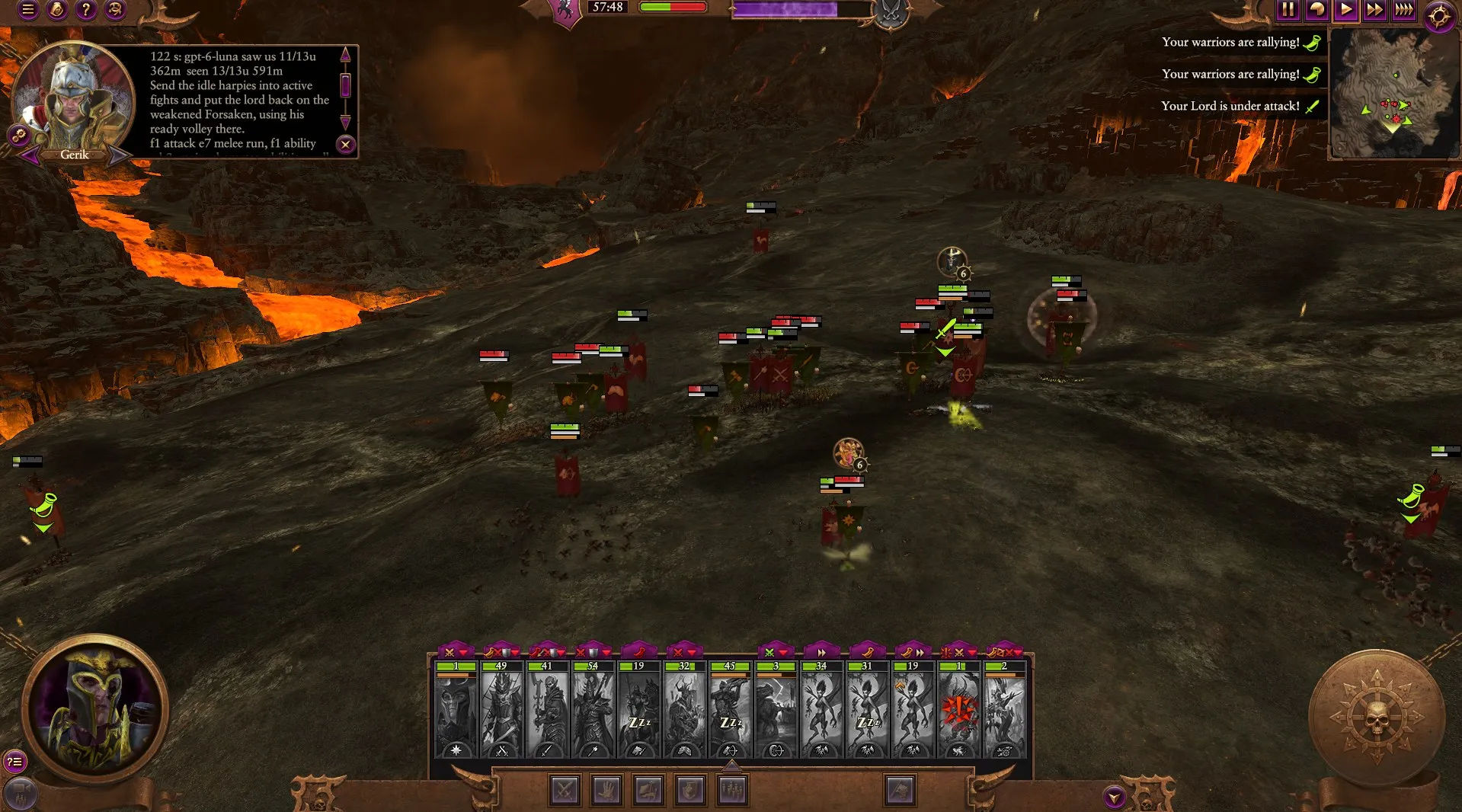
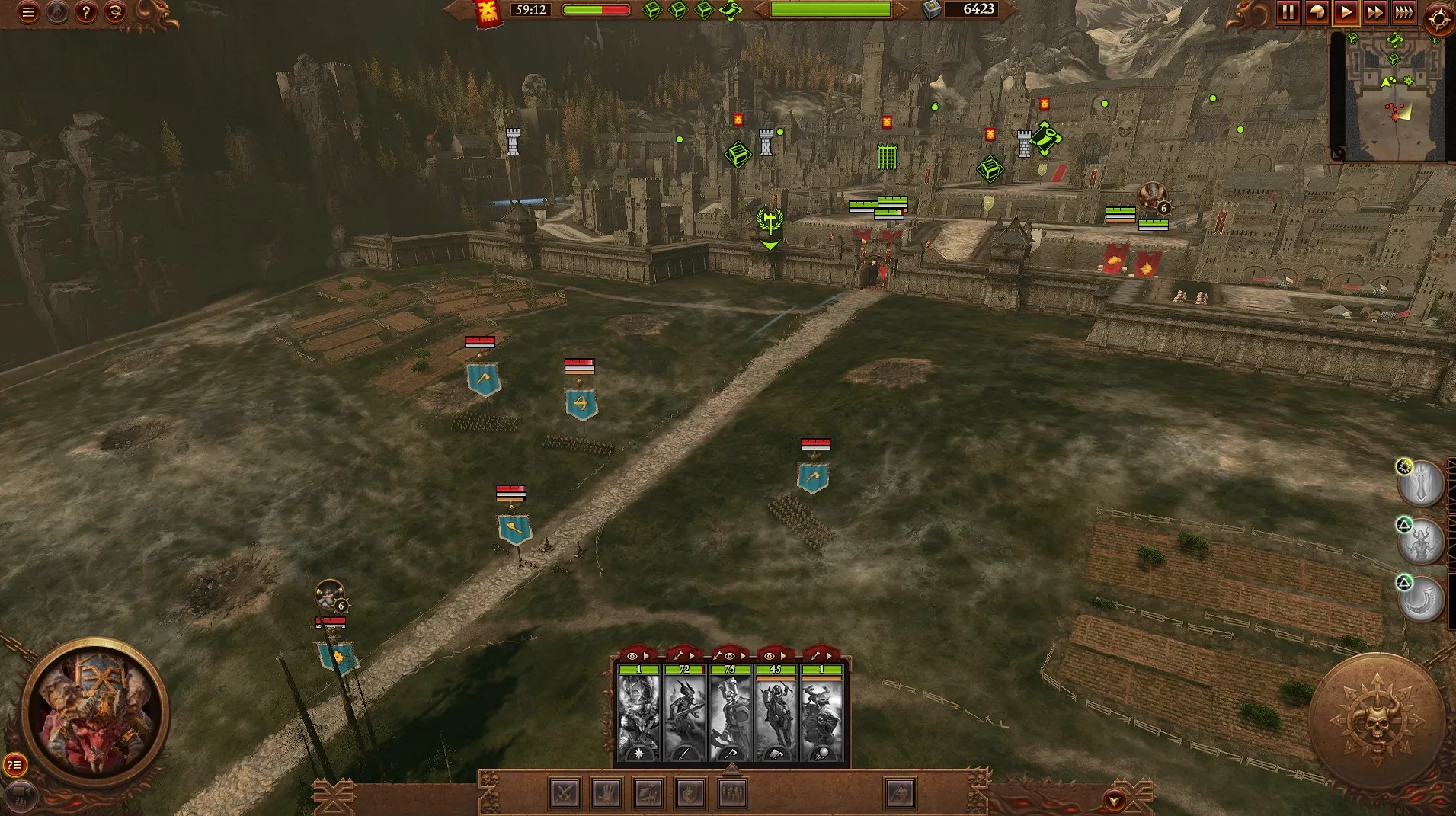
The mod can also show each reply inside the game. Both captures are from early development.
Slay the Spire: full runs
In Slay the Spire a bad choice can end a run an hour later. A model plays complete Ironclad runs via CommunicationMod: at each decision it sees a summary of the public game state, the legal choices labeled one by one, its recent decisions and its own notes. When a recorded run shows a mistake, I change one part of the prompt, memory or interface and run again.
9447
Floor 54 Spire Shield & Spear
- HP
- max HP
- elite
- boss
- rest
- shop
No run has won yet.
Some mistakes came from the interface rather than from the model’s decisions. With the Gambling Chip relic, the game asks at the start of a fight which cards to discard and redraw. The prompt said only “Choose up to 99 card(s) from your hand”, with the same select-and-confirm choices the model used to pick a card to upgrade, so it sometimes picked cards it meant to play. On floor 42 of one run it selected Impervious+ “to block the Transient’s full 30 damage and avoid dying this turn”, and the card went to the discard pile. The same misreading came back in later versions. The newest prompt adds one line naming what asked for the selection. Replayed over the saved traces it changes only the 385 hand-selection prompts, but it hasn’t had a full run yet.
I also ran small first-combat training pilots (paused for now), and training on full runs is planned (details below).
Interface, pilots and plans
- CommunicationMod exposes the public game state. The draw pile is shown unordered unless the Frozen Eye relic is held, and the model gets no seed, random-number state, or card and relic text.
- Runs use the Ironclad at Ascension 0 with gpt-6-luna on low reasoning effort. The prompt, memory and interface are on their tenth version, each changing one thing, and the furthest run was on version 8.
- The first-combat pilots compared a scripted heuristic, PPO and a LoRA fine-tune of Qwen3-0.6B, run locally on fixed floor-1 fights. The LoRA matched the heuristic’s average remaining HP on a three-encounter development set (76.33 against 76.00, over 12 attempts), but PPO changed its weights without improving play.
- Planned, with only a code skeleton so far: reinforcement learning on full runs with open-weight models on remote hardware, starting with Qwen3.6-35B-A3B and then GLM-5.3.